
In the foreign exchange, precious metals, and OTC derivatives markets, STP and ECN are the mainstream execution models for institutional-grade liquidity services. Both belong to the pure A-Book No Dealing Desk (NDD) system , with the core logic that orders go directly into the real interbank market, and the service provider does not act as a counterparty. As a leading institutional-grade liquidity service provider in the liquidity ecosystem, Macro Group is a typical practitioner of the STP/ECN model. Its end-to-end implementation fully demonstrates the operational logic, core advantages, and compliance value of this model.
I. Clarifying Concepts: What are STP and ECN respectively?
Both STP and ECN are non-market maker-based straight-through trading models, but they differ fundamentally in their order matching mechanisms and fee structures.
1. STP (Straight Through Processing)
The core of STP (Straight Through Processing) is order processing without delays, internal hedging, or human intervention . After a client submits an order, the service provider does not perform any internal processing or risk assumption; it directly forwards the order through technical channels to upstream Tier-1 banks, exchanges, and other liquidity providers, where it is matched and executed by counterparties in the real market. The service provider's profit primarily comes from a small markup on the original spread; it typically does not charge separate trading commissions. The profit model is clear and transparent, and completely unrelated to the client's profits or losses.
2. ECN (Electronic Communications Network)
The core of ECNs is multi-source aggregation and centralized matching . Service providers aggregate quotes from multiple banks, market makers, and institutional clients through electronic communication networks, forming a unified, deep public order book. All orders are automatically matched and executed within this order book according to the rule of "price priority, time priority." Service providers profit primarily by charging fixed commissions based on trading volume, conveying the original interbank spreads to clients, and ensuring that price formation is entirely determined by market supply and demand, resulting in extremely high transparency.
Macro Group Combinatorial Practice
In actual operation, Macro Group adopts a hybrid model of "ECN liquidity aggregation + STP direct execution" : the bottom layer aggregates liquidity from multiple sources such as the StoneX exchange network and the Integral OTC system through ECN logic to form a global deep order book; the upper layer uses the STP channel to directly connect orders to the interbank market 100%, which takes into account both the liquidity depth of multi-source aggregation and ensures the efficiency and stability of order execution.
II. Core Advantages of the STP/ECN Model (Macro Group Sample Implementation)
1. Zero conflict of interest: Eliminating antagonism at the root of the business model.
This is the most essential characteristic of the STP/ECN model, and also the core feature that distinguishes it from the B-Book market maker model.
- The underlying logic of the model is that the service provider's revenue comes solely from transparent spread markups or trading commissions, and is completely unrelated to the client's trading profits and losses. Client profits do not cause service provider losses, and client losses do not generate additional profits for the service provider; there is no zero-sum game between the two.
- Macro Group's exemplary practices : The group adheres to a 100% pure A-Book model across all its businesses, completely refraining from B-Book internal betting activities. Its revenue structure is clear and singular, charging only liquidity channel service fees. All orders are routed to the upstream Tier-1 interbank market, ensuring that client trading profits and losses do not affect the group's revenue. This eliminates the motivation for moral hazard such as manipulating prices, delaying orders, and restricting withdrawals at the root of the business, aligning the interests of service providers, partner brokers, and end clients entirely.
2. True market pricing: Eliminating the possibility of slippage through human manipulation from a systemic perspective.
In the STP/ECN model, both the quoted price and the transaction price are derived from the real market. The service provider itself does not have the power to set prices, thus eliminating the possibility of human intervention in pricing.
- The underlying logic of the model is that the price quotes come directly from the real supply and demand in the interbank market and exchanges, and the transaction price is generated by market matching. Service providers cannot manually modify the quotes or adjust the slippage, and the price formation process is transparent and verifiable.
- Macro Group's exemplary practice : Full quote depth is directly derived from real market quotes from the StoneX global exchange network and the Integral OTC market-making system, eliminating secondary pricing and manual quote processing. Order routing is driven entirely by intelligent algorithms, with zero human intervention; transaction prices are determined solely by market supply and demand. A complete log is maintained for each transaction, recording the quote source, transaction path, and transaction price, ensuring traceability and verification.
3. Deep liquidity support: Large orders are executed with low impact.
ECN's multi-source aggregation effect results in a deeper order book, significantly improving the ability to accept large orders and reducing the market impact cost of large transactions.
- The underlying logic of the model is to aggregate quotes from multiple liquidity providers to form a multi-layered order book, allowing large orders to be matched and executed in segments at multiple price levels, minimizing the impact on market prices and reducing slippage costs.
- Macro Group's exemplary practice : Leveraging a dual-underlying liquidity architecture of "on-exchange channels + off-exchange market-making quotes," it directly connects to over 40 global derivatives exchanges and over 180 interbank foreign exchange markets, covering over 16,000 OTC stocks with ample quote depth across all categories. Coupled with an intelligent order routing algorithm, large orders can be automatically split and matched with the current optimal quote path, ensuring execution efficiency while minimizing market impact and slippage costs for large transactions, and stably handling large institutional-level fund transactions.
4. End-to-end traceability: Naturally adapted to stringent regulatory requirements.
The entire transaction process in the STP/ECN model is clearly traceable, which naturally meets the core requirements of strict financial regulation for transaction transparency and customer protection.
- The underlying logic of the model is that each order has a clear upstream counterparty and transaction path, and the transaction records are complete and auditable, which can meet the requirements of regulatory agencies for thorough verification.
- Macro Group's best practices : From order submission, routing, matching, and settlement to fund clearing, a complete log is maintained throughout the entire process, including core information such as order number, execution time, execution price, counterparty, and routing node. All orders are executed through the main Australian channel regulated by ASIC (Australia's ASIC regulatory body). Trading standards and fund clearing are uniformly incorporated into the core regulatory framework, fully complying with the requirements of multiple jurisdictions, including ASIC in Australia and SFC in Hong Kong, and can be directly audited by regulatory bodies.
5. Indiscriminate trading environment: compatible with all types of trading strategies.
Since there is no conflict of interest, STP/ECN service providers have no incentive to restrict clients' trading methods and treat all trading strategies and account types equally.
- The underlying logic of the model is that the service provider does not bear the risk of transactions and will not suffer losses due to the client's profits. Therefore, there are no hidden restrictions on profitable accounts, high-frequency trading, or scalping strategies.
- Macro Group's exemplary practices : No profit caps are set for any trading account, profitable orders are not blocked, and trading strategies are not restricted. Whether it's day scalping, high-frequency algorithmic trading, or medium- to long-term holding, whether it's a small retail account or a large institutional fund, all enjoy the same execution standards and liquidity services, without discrimination based on account type or trading style.
6. Enhanced Fund Security: Reducing Fund Risk from the Business Model Level
Under the STP/ECN model, service providers do not need to take over customer positions, which reduces the risk of fund occupation and misappropriation from a business logic perspective.
- The underlying logic of the model is that all orders go directly to the real market, and service providers do not need to use their own funds or customer funds for internal risk hedging. There is no motivation or scenario to use customer funds to cover losses.
- Macro Group's exemplary practice : Utilizing its "triple segregation system," client funds are strictly separated from company operating funds, and are held in full in independent escrow accounts at top global banks. Fund transfers correspond one-to-one with order execution, and every fund settlement is matched with real market transaction records. From business model to escrow structure, this dual protection safeguards fund security in all aspects.
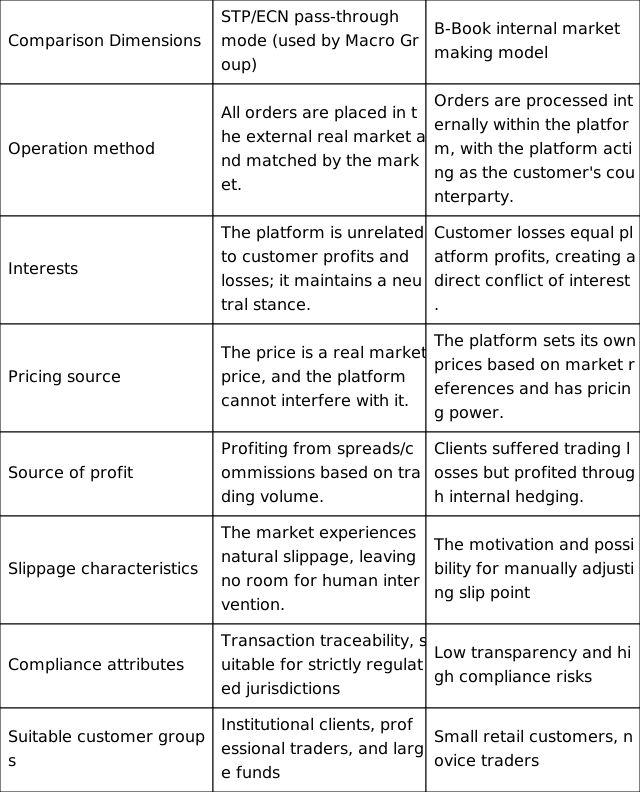
III. Model Comparison: STP/ECN vs B-Book Market Maker Model
IV. Summary
The STP/ECN straight-through model represents the development direction of transparency and standardization in the global liquidity industry. It is not only an order execution technology, but also a business philosophy of "profit neutrality and customer priority".
Macro Group's practices have transformed the advantages of the STP/ECN model from abstract concepts into a tangible service experience: from underlying liquidity supply and order execution logic to fund security and multi-regional compliant operations, the core principle of pure direct access is implemented throughout the entire chain. It is precisely this long-term commitment to the STP/ECN model that has built Macro Group's foundation of trust, enabling it to join the top tier of the liquidity ecosystem and become a trusted institutional-grade liquidity partner for global brokers.