
The Dual-Channel Quantum-Well Annihilation-Field Model — Ultimately Developing into Super Quantum Wells and the Conditions for the Existence of the Universe
—— A Summary of the Special-Topic Discussion
—— A Special-Topic Volume of the Parent Monograph “The Dual-Channel Quantum-Well Annihilation-Field Model: A Self-Consistent Derivation from Underlying Postulates to Macroscopic Phenomena”
Author: Lu Weihui
Date: November 2026
Note: This volume is a summary of the special-topic discussion of the parent monograph “The Dual-Channel Quantum-Well Annihilation-Field Model: A Self-Consistent Derivation from Underlying Postulates to Macroscopic Phenomena”. Postulate 1.8 of the parent monograph states the current understanding that “the cosmos is one gigantic nested quantum well, nesting within nesting, infinitely”. The volume systematically organises the concept of the “super quantum well” derived in the discussion together with the cross-level crossing of super particles, as well as the final positioning that “the super-quantum stage does not contradict the ordinary universe”; and it sets out as Chapter 2 the basic conventions of the system concerning density, nesting level and the three kinds of quantum wells, on which all later chapters rest. No new postulate is introduced; all criteria follow Postulates I–VI and the postulate-level laws L1–L5; whatever is extrapolated is labelled “special-topic extrapolation / current understanding” and may be revised later. The volume gives only structural formulas and criteria; numerical values await calibration, and no numerical assertion is made. One basic convention of this system is that the scale of a quantum well may be defined at will — it may be taken as invariable or taken as zero, as large or as small as one pleases; its specific size is not reckoned in this system. Quantum wells differ only in nesting level, and “ordinary” and “super” are both generic expressions: whether a quantum well is a super quantum well is judged only by whether its nesting layers are exceptionally numerous, while how its layers are arranged inside it belongs to its internal structure, which cannot presently be determined in this system and is not assumed. This system no longer retains the concept of “space”; “space-time” is still retained as a physical quantity, its entire content being expressed by the nesting level; and a length converted out of space-time is merely a physical quantity that can be so converted — being convertible is all that is required. As for the walking of a photon, only the step count is reckoned: once it has walked through the levels from inside to outside, one complete stepping is accomplished; and even if it does not move at all but merely advances in level, it is likewise regarded as having accomplished the stepping through the infinitely nested quantum wells. In defining a super quantum well this system retains only two things: the absolute nesting number and the total number of quantum wells; every other physical quantity may be discarded. Length does not serve as a basis for describing a quantum well, and the specific size of the nesting level is likewise not reckoned. The behaviour between the two levels can be decided only by the basic properties of the annihilation pairs; the sizes are each definable at will, and both the sizes and the steps are observable. The relation between this system and a super quantum well is one-way — it can affect us only, and we cannot affect it; and this system has no power to block it. All the particles of a super quantum well are extremely harmful to this cosmos, and were they present in this cosmos it could not exist; yet the vacuum around a super quantum well (that is, a neutral quantum well) does have the conditions for constituting a cosmos — it is neutral and formatted, it has ready-made positive and negative quantum wells, and it is outwardly neutral, fairly stable, and unharmed by other super particles. A super photon is not an ordinary photon — it carries moving positive energy and possesses sufficient attraction, so that a special vacuum and possibly an accretion disk may form around it, and it must be regarded at least at the level of a black hole. This system also accepts the following: a super quantum well has its super neutral quantum well (that is, what this system calls the super vacuum); and a region inside it, say this neutral quantum well, may likewise develop into a cosmos-like structure — light walking within it merely puts its foot down and leaves at once, without destroying its structure, while other particles likewise merely pass through on the way with no evident effect; only half of it, inward, consists of positive-energy quantum wells, and it is precisely this half that can form that cosmos, its distribution being much the same as that of our cosmos — by and large flat — because it is outwardly neutral and has not much that is polarised (6.2). The scope of this volume is here made clear: it does not treat how a super quantum well is itself constituted, nor does it analyse why or how it decomposes — it is a super quantum well, and no external force can make it do this or that; nor does this system possess any formula by which to verify it. This volume deals only with the influence of a super quantum well upon the external space-time, above all upon this cosmos; a super quantum well also has its accretion disk, but what it produces is harmful matter that cannot form a cosmos, so it is mentioned only in passing (4.2, 4.3).
Contents
Abstract
Chapter 1 Background and Positioning of the Discussion
1.1 The starting point of the discussion
1.2 Review of the criteria already established
1.3 Positioning of this volume
Chapter 2 The Basic Conventions of the System
2.1 The three kinds of quantum wells
2.2 Density is a generic quantity; the nesting density determines the quantum-well level
2.3 Density refers specifically to the aggregation-reaction density of positive annihilation pairs
2.4 The three kinds of quantum wells and the nesting levels
2.5 A super quantum well contains ordinary quantum wells: its internal structure is not yet determined
2.6 The nesting level determines everything: definable scale, level only
2.7 Space-time and step count: recognising level and quantum-well count only
2.8 A super quantum well has only two things: the absolute nesting number and the total number of quantum wells
2.9 Sizes definable at will: freely definable and observable
Chapter 3 Application and Ranking of the Local Matter-Generation Criteria
3.1 Planet and stellar interiors: the criteria are largely unsatisfied
3.2 Black-hole interiors: high energy density, nucleation undetermined
3.3 Other high-speed, high-pressure regions: ranked by degree of influence
Chapter 4 The Proposal of the Super Quantum Well
4.1 Definition of the super quantum well
4.2 The scope of this volume: only its influence upon the external space-time
4.3 The accretion disk: mentioned only in passing
Chapter 5 The Cross-Level Crossing of Super Particles
5.1 The two crossing mechanisms
5.2 No ranking by ease: this system has no power to block it
5.3 The performance of the super photon in our space-time: independent of speed, and beyond this system’s knowledge
5.4 The harm super particles do to this cosmos: this cosmos cannot hold them
5.5 The gravitational property of the super photon: to be regarded at least at the level of a black hole
5.6 The electron and the “super electron”
Chapter 6 Final Positioning: the Super-Quantum Stage does not Contradict the Ordinary Universe
6.1 The super-quantum stage is the extreme stage of the ordinary universe's evolution
6.2 A region inside a super quantum well may likewise develop into a cosmos-like structure
Chapter 7 Conclusion
Abstract
This volume puts a round of special-topic discussion about super quantum wells into written form. In it the system has mainly done the following things: first, it sets up the thread of the “super quantum well”, retaining in its definition only two things — the absolute nesting number and the total quantum-well count; second, it lays down the basic conventions — “space” is no longer retained, everything is spoken of by nesting level, and the scale of a quantum well may be defined at will and is observable; third, it fixes the relation between the two sides as one-way — it can affect us only, and we cannot affect it; fourth, it identifies the harm super particles do to this cosmos; fifth, it points out what genuinely has the conditions for constituting a cosmos — the vacuum around a super quantum well, that is, a neutral quantum well — and that a region inside it may likewise develop into a cosmos-like structure.
Chapter 1 Background and Positioning of the Discussion
1.1 The starting point of the discussion
This round of discussion starts from a set of concrete questions: whether chain reactions inside a planet can trigger the decomposition of neutral quantum wells; whether the “too fast a reaction, too short a life” of supermassive stars is related to the decomposition of neutral quantum wells; whether decomposition can occur at the centre of Jupiter; whether a black hole has the ability to decompose when its internal pressure is sufficient; and which near-light-speed high-pressure regions in the cosmos, besides black holes and stellar interiors, may trigger decomposition.
1.2 Review of the criteria already established
Three criteria are used repeatedly in the discussion; all have been given in the parent monograph and its special topics, and are adopted here without re-derivation:
Decomposition criterion:
P_local > u_N = ε_N · n_N (1-1)
Nucleation criterion:
S⁺ = η n_N v / λ_front > (β⁺)² / α⁺ (1-2)
Energy constraint:
P_grav ≥ P_open + P_form (1-3)
1.3 Positioning of this volume
This volume is a summary of the special-topic discussion: it systematically organises the concept of the “super quantum well” derived in the discussion and the related questions, labelling them as “special-topic extrapolation / current understanding” rather than as postulates of the parent monograph. All criteria follow the parent monograph in structure, and numerical values await calibration. The basic conventions of this system concerning density, nesting level and the three kinds of quantum wells are set out in Chapter 2; all the remaining chapters of this volume take them as their premise.
Chapter 2 The Basic Conventions of the System
This chapter establishes the basic conventions of the system concerning density, nesting level and the three kinds of quantum wells. The following provisions are the current conventions of the system, and all later argument in this volume takes them as its premise.
2.1 The three kinds of quantum wells
The parent monograph gives three kinds of quantum wells. The positive quantum-well equation contains the self-catalytic aggregation term:
∂ρ⁺/∂t = +α⁺(ρ⁺)² − β⁺ρ⁺ + D⁺∇²ρ⁺ − ηρ⁺ρ⁻ (2-1)
Its self-catalytic term +α⁺(ρ⁺)² makes positive quantum wells become locally dense.
The negative quantum-well equation contains the self-catalytic repulsion term:
∂ρ⁻/∂t = −α⁻(ρ⁻)² − β⁻ρ⁻ + D⁻∇²ρ⁻ − ηρ⁺ρ⁻ (2-2)
Its self-catalytic term −α⁻(ρ⁻)² makes negative quantum wells diffuse on their own and be pushed aside.
The neutral quantum well is neutral to the outside, with its internal positive and negative annihilation pairs partitioned and insulated (Postulate VI), showing no net attraction, net repulsion or tension to the outside. Their behaviours differ and their roles differ, but they are three constituent parts of one and the same structure, not three mutually independent things.
2.2 Density is a generic quantity; the nesting density determines the quantum-well level
“Density” in this system is not a directly measurable physical quantity belonging to one particular kind of structure, but a generic quantity — a unified name for “how many and how tightly packed the quantum-well structures are at a given level and in a given region”, retained as a substitute symbol for mathematical convenience. The system adopts a unified convention: the nesting density (that is, the nesting level) is taken as the basis of density, and the nesting density determines the level of a quantum well.
· One does not ask “how dense is it” but “in which layer is it nested”; density, a continuous and uncertainly measured quantity, is replaced by the countable quantity of the nesting level.
· Density and level stand in a one-to-one monotonic relation: writing the nesting layer count as k,
ρ → k; a larger k means a higher equivalent density, a smaller k a lower one (2-3)
· High density = many nesting layers = high level; low density = few nesting layers = low level.
2.3 Density refers specifically to the aggregation-reaction density of positive annihilation pairs
As soon as “reaction” is involved — aggregation, nucleation, equilibrium, locking, release — density refers specifically to the aggregation-reaction density between positive annihilation pairs, that is, ρ⁺ in Postulate II. This is the subject of every criterion in this volume.
Positive annihilation pairs are the sole reaction subject. Postulate II gives the positive quantum-well equation with the self-catalytic aggregation term +α⁺(ρ⁺)², whose equilibrium density is:
ρ*⁺ = β⁺ / α⁺ (2-4)
All judgements about “dense or not”, “strong reaction or not”, “can it nucleate or not” concern the aggregation density of positive annihilation pairs.
Neutral quantum wells are the carriers after being opened. A neutral quantum well is neutral to the outside and does not itself take part in the aggregation reaction; but after it is temporarily decomposed by external energy density (Postulate VI), the positive annihilation pairs that appear inside it obey the very same set of reaction conditions — they have merely changed the place in which they appear, and are not another kind of density.
Negative annihilation pairs are represented by the density of the nesting level. Negative annihilation pairs cannot presently be measured and cannot be directly identified, nor can a density be written for them directly. Their existence can only be reflected indirectly through the density of the nesting level — that is, through the degree to which the negative quantum-well grid described by Postulates IV and V is modulated, and through how tightly the layers are nested. Negative annihilation pairs have no other outlet: their density is the density of the nesting level.
In one sentence: the ruler of density in this system measures only one thing — the aggregation reaction of positive annihilation pairs; the positive annihilation pairs inside an opened neutral quantum well are measured by the same ruler; and negative annihilation pairs are read off indirectly through the density of the nesting level.
2.4 The three kinds of quantum wells and the nesting levels
The kinds of quantum wells recognised in this system are still only the three given in the parent paper — positive, neutral and negative. As for what the inside of a nesting layer is actually like, and how they are arranged within a level, this system does not know and does not describe it.
The behaviour of each of the three kinds is given by the postulates: positive quantum wells become locally dense through self-catalytic aggregation; negative quantum wells diffuse on their own and are pushed aside through self-catalytic repulsion; a neutral quantum well is neutral to the outside, with its internal positive and negative annihilation pairs partitioned and insulated (Postulates II, VI). What this system now calls “the vacuum” is the neutral quantum well. The deeper the level, the more numerous the nesting layers and the higher the equivalent density, but the kinds do not change — however “dense” it becomes, there remain only these three.
2.5 A super quantum well contains ordinary quantum wells: its internal structure is not yet determined
According to the nesting picture of Postulate 1.8, the scale of a quantum well may be defined at will: it may be taken as invariable or taken as zero, as large or as small as one pleases, and its specific size is not reckoned in this system. Quantum wells differ only in nesting level, not in size. “Ordinary quantum well” and “super quantum well” are both generic expressions — the scale of either may be defined at will, and a super quantum well merely has an exceptionally large number of nesting layers. What is called nesting is nesting of layers, not of sizes: within the outer layer an inner layer is nested, and within that inner layer a yet more inner layer; there are not “two different kinds of quantum wells” here but only different levels of one and the same nesting structure.
How the nesting layers of a super quantum well are arranged inside it — for instance whether the inner layers are numerous and the outer layers few — belongs to its internal structure.
This internal structure cannot presently be determined in this system, nor is it assumed: whether a quantum well is a super quantum well is judged only by whether its nesting layers are exceptionally numerous, and no particular mode of distribution is required; how it distributes itself is decided by itself.
Whether quantum wells nest within nesting depends on the setting in which the expression is used. For integral objects such as a black hole or the cosmos as a whole, it is appropriate to say that they nest within nesting and are self-similar; but at the level of an elementary particle, say an electron, how the quantum wells outside it and the positive quantum wells inside it are to be apportioned, and whether they likewise nest within nesting, this system cannot say clearly and makes no assertion — unless a single quantum well is itself defined as nesting within nesting, in which case such a quantum well could no longer be defined. This system therefore says only this: in settings such as a black hole or the cosmos as a whole, quantum wells are organised by nesting level, nesting within nesting; in settings such as an elementary particle, no assertion is made.
2.6 The nesting level determines everything: definable scale, level only
The scale of a quantum well is a matter of definition: it may be defined as large as one pleases or as small as one pleases, and that scale may be taken as invariable or taken as zero. This system does not reckon its specific size, and recognises level alone: quantum wells differ only in nesting level, not in size. In this system there is only level, not volume; everything this system speaks of rests on the nesting level. “Ordinary” and “super” are both generic expressions: the scale of a super quantum well may likewise be defined at will, and it merely has an exceptionally large number of nesting layers. In defining a super quantum well this system retains only two things: the absolute nesting number and the total number of quantum wells; every other physical quantity may be discarded.
A length converted out of space-time is merely a physical quantity that can be so converted:
L = L(k), where k is the nesting-layer count (2-5)
being convertible is all that is required — it does not serve as a basis for describing a quantum well, and the specific size of the nesting level is likewise not reckoned. The equivalent density, the level of a quantum well, and every physical effect are all determined by the nesting level:
ρ_eff = ρ_eff(k), Level = Level(k), physical effect = F(k) (2-6)
The nesting level is the sole basis of any change in this system.

2.7 Space-time and step count: recognising level and quantum-well count only
This system no longer retains the concept of “space”. “Space-time” is still retained as a physical quantity, but it is not expressed by length or volume: the entire content of space-time is expressed by the nesting level — space-time is the nesting level of quantum wells itself. From space-time (or from the level) a length may be converted out, but that is merely a physical quantity that can be so converted — being convertible is all that is required; it does not serve as a basis for describing a quantum well: this system describes quantum wells by the absolute nesting number and the total number of quantum wells alone.
As for the walking of a photon, only the step count is reckoned. A photon travels through the nested quantum wells, stepping level by level from inside to outside; once it has walked through the levels from inside to outside, one complete stepping is accomplished. Whether it has “finished walking” is judged not by whether it has moved a distance but only by how many levels it has passed through — even if it does not move at all and merely advances in level, it is regarded as having accomplished the stepping through the infinitely nested quantum wells.
N_step = Δk, step count = level difference (2-7)
Accordingly, the physical quantities measured in this system can all be converted into the nesting level of quantum wells; step count and level are two ways of saying one and the same measure. In defining a super quantum well this system retains only two things: first the absolute nesting number, and second the total number of quantum wells; every other physical quantity may be discarded. As for the specific size of the nesting level, this system does not reckon it.

2.8 A super quantum well has only two things: the absolute nesting number and the total number of quantum wells
The definition of a super quantum well in this system converges on two quantities:
S = { k_abs , N_total } (2-8)
Here k_abs is the absolute nesting number, namely the number of layers obtained by counting its nesting levels absolutely; and N_total is the total number of quantum wells, namely the total count of the quantum wells it contains. Whether a quantum well is a super quantum well, and at which grade it stands, is judged by these two quantities alone.
Apart from these two quantities, every other physical quantity may be discarded: pressure, density, volume, scale, energy, momentum, the speed of light, time and so on form no part of the definition of a super quantum well, and this system does not take them as the basis for delimiting a super quantum well.
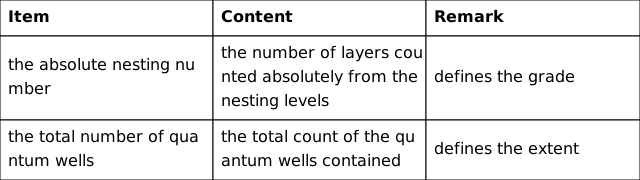
In one sentence: a super quantum well has only two things — the absolute nesting number and the total number of quantum wells; apart from these two, every other physical quantity may be discarded.
2.9 Sizes definable at will: freely definable and observable
The size of a quantum well is definable at will by each side: this system may define an arbitrary size for the quantum wells of the ordinary level (call it size A), and the super level may define an arbitrary size for its own quantum wells (call it size B); the two sizes are each arbitrary, each freely definable, and each observable. By way of a figurative example, the number density of the quantum wells contained in one super quantum well may be a hundred million times that of the ordinary level.
The sizes and steps of the two levels are observable: when size B is larger than size A it crosses in a single stride, and when size B is far smaller than size A (a hundred-millionth, say) how it steps can likewise be observed.
The behaviour between the two levels is decided only by the basic properties of the annihilation pairs: positive annihilation pairs aggregate, negative quantum wells expand outward, and neutral quantum wells are externally neutral.
Chapter 3 Application and Ranking of the Local Matter-Generation Criteria
3.1 Planet and stellar interiors: the criteria are largely unsatisfied
By the decomposition criterion (1-1), the central pressure of a planet is far below u_N. Although the central pressure of a supermassive star is high, the central v is small and η small, so the nucleation criterion (1-2) is hard to satisfy:
S⁺ = η n_N v / λ_front ≪ (β⁺)² / α⁺ (3-1)
Conclusion: planet and stellar interiors are not the main channel by which neutral quantum wells decompose to generate matter; the “short life” of supermassive stars is still explained mainly by the luminosity–mass relation, and the decomposition mechanism is at most a correction term.
3.2 Black-hole interiors: high energy density, nucleation undetermined
Inside a black hole P_local is extremely high, and the decomposition criterion (1-1) is satisfied with high probability:
P_local ≫ u_N = ε_N n_N (3-2)
η approaches 1:
η = ( P_local − u_N ) / P_local → 1 (3-3)
But the nucleation criterion depends on the internal v and λ_front. If n_N is extremely high and λ_front very small, nucleation may occur even when v is not large; if v is small and n_N insufficiently high, decomposition occurs without nucleation.
3.3 Other high-speed, high-pressure regions: ranked by degree of influence
The other high-speed, high-pressure regions of the cosmos are ranked by “decomposition criterion + nucleation criterion + duration + degree of influence”, with the results in the table below.
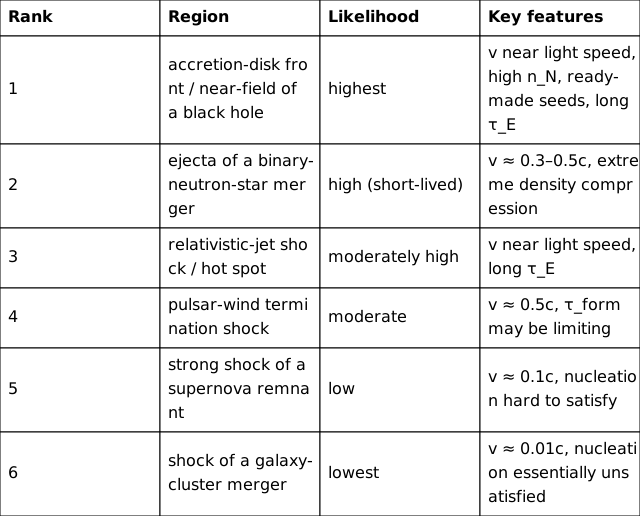
Conclusion: the black-hole accretion disk is the most realistic candidate for a “matter factory” within the model; binary-neutron-star mergers are a “short-lived, high-yield and key site for heavy elements”; the remaining regions are mostly “decompose without nucleating” or of minor influence.
Chapter 4 The Proposal of the Super Quantum Well
4.1 Definition of the super quantum well
According to the nesting picture of Postulate 1.8, this system calls a quantum well with an exceptionally large number of nesting layers a super quantum well. It is not a new object, nor something of another size — its scale may be defined at will (taken as invariable or taken as zero), its specific size is not reckoned in this system, and it merely has an exceptionally large number of nesting layers; “ordinary” and “super” are both generic expressions. For convenience of exposition, this volume still uses the names “super quantum well / ordinary quantum well” for different levels of one and the same nesting structure, but the two refer to one and the same object. As a definition, a super quantum well has only two things — the absolute nesting number and the total number of quantum wells (2-8); apart from these two, every other physical quantity may be discarded.
4.2 The scope of this volume: only its influence upon the external space-time
The scope of this volume is here made clear: it does not treat how a super quantum well is itself constituted, nor does it analyse why or how it decomposes — it is a super quantum well, and no external force can make it do this or that; nor does this system possess any formula by which to verify it. This volume deals only with the influence of a super quantum well upon the external space-time, above all upon this cosmos.
4.3 The accretion disk: mentioned only in passing
A super quantum well also has its accretion disk. It is mentioned here only in passing: what it produces is harmful matter that cannot form a cosmos (see 5.4); its accretion disk is not further developed in this volume.
Chapter 5 The Cross-Level Crossing of Super Particles
5.1 The two crossing mechanisms
· Mechanism A: an entity particle must “open” the boundary layer.
Criterion:
P_particle > u_N^ordinary = ε_N n_N (5-1)
· Mechanism B: waves / near-symmetric structures “do not rely on opening”.
A photon, by Postulate V, walks grid by grid along the infinite nesting levels of the nested quantum wells — counting steps only, counting no distance — and need not “open” the boundary layer:
N_step = Δk, the light walks along the nesting levels (5-2)
A neutrino, by the measurability criterion, is a near-symmetric nesting whose net pressure difference tends to zero:
ΔP = P⁺ − P⁻ ≈ 0 < P_th (5-3)
and it penetrates by “not interacting”.
Whether the two mechanisms above hold depends in the end on the basic properties of the annihilation pairs that compose the quantum wells: positive annihilation pairs aggregate; negative quantum wells expand outward (this is a tendency, not limited by positive energy); and neutral quantum wells are externally neutral (having no external boundary, not limited by any physical quantity). The behaviour between the two levels can be decided only by the basic properties of the annihilation pairs; no other physical quantity can decide it.
5.2 No ranking by ease: this system has no power to block it
This system makes no ranking of ease for the crossing of super particles: it has no power to block a super particle, and no kind of quantum well can block its crossing. Whether they can cross is decided only by the basic properties of the annihilation pairs.
5.3 The performance of the super photon in our space-time: independent of speed, and beyond this system’s knowledge
As regards the super photon itself, it is not an ordinary photon — it carries ultra-high energy and also carries moving attraction; so one cannot simply say that “breakthrough is not matter generation”.
But this cannot be tested within this system at all. What a super photon would have to break through is the neutral quantum-well layer of this system — the vacuum as this system speaks of it; this system has no such experiment, nor can it have one. And since the experiment cannot be made, the performance of a super photon is likewise beyond this system’s knowledge.
What must be made clear is this: a super photon is not to be regarded as a high-speed moving body, nor is it to be explained by the line that “it carries temporary positive pressure ahead of it”; its effect in our space-time has nothing to do with speed. Even if its speed of motion is very slow, an accretion disk will arise around it through the action of gravitation, and this will cause the separation of the neutral quantum wells around it (that is, of what this system calls the vacuum); and any temporary annihilation pair will likewise be separated. What is relied on is not speed but the large positive energy it carries — where the positive energy is large, there must be a superlatively strong attraction around it, and an accretion disk forms (see 5.5).
As for the step of matter generation itself, the criterion of this system remains the nucleation criterion (1-2) together with the multi-point accumulation condition:
S⁺ = η n_N v / λ_front > (β⁺)² / α⁺ (5-4)
Even so, the performance of a super photon in our space-time is entirely beyond this system’s knowledge, and whether this step constitutes an obstacle for it is not asserted by this system.
5.4 The harm super particles do to this cosmos: this cosmos cannot hold them
This section sets out the relation between super particles and this cosmos. The conclusion first: all the particles of a super quantum well are extremely harmful to this cosmos. Taken one by one — super photon, super neutrino, super electron, super proton / hydrogen ion — not one of them can constitute this cosmos; and were such particles present within this cosmos, this cosmos could not exist. In a word, this cosmos cannot hold them. This is a current understanding of this system, labelled a special-topic extrapolation and revisable later.
The relation between this system and a super quantum well remains one-way: it can affect us only, and we cannot affect it.
5.5 The gravitational property of the super photon: to be regarded at least at the level of a black hole
One further property must be added: a super photon is not an ordinary photon. An ordinary photon has no effect on a neutral quantum well (that is, on what this system calls the vacuum); a super photon is different — being a super photon, it carries moving positive energy, and by this system it therefore possesses sufficient attraction. This sufficient attraction is precisely its greatest characteristic.
Having a superlatively strong attraction, it may form around itself a special kind of vacuum, and possibly an accretion disk as well. That is to say, a super photon carries a “surrounding” of its own, rather than being, like an ordinary photon, merely something that passes through.
One more point must be made clear: this property has nothing to do with speed. Even if the speed of a super photon is very slow, an accretion disk will arise around it through the action of gravitation and will cause the separation of the neutral quantum wells around it (that is, of the vacuum); and any temporary annihilation pair will likewise be separated. These super photons must therefore be regarded at least at the level of a black hole. This is the current understanding of this system regarding the properties of the super photon, labelled a special-topic extrapolation and revisable later.
The direction of the influence must be made clear: the influence of a super quantum well upon this system is one-way — it can affect us only, and we cannot affect it; reduced to essentials, this is all there is to it. This system exerts no effect upon it at all. As for the accretion disk around it and whether it radiates outward, this system cannot know; any item-by-item listing is less accurate than this one sentence. This is the current understanding of this system regarding the influence between the two, labelled a special-topic extrapolation and revisable later.
5.6 The electron and the “super electron”
This system defines the electron as follows: the electron is a positive quantum well, with negative quantum wells around it.
Chapter 6 Final Positioning: the Super-Quantum Stage does not Contradict the Ordinary Universe
6.1 The super-quantum stage is the extreme stage of the ordinary universe's evolution
By Postulates II and IV — the self-catalytic aggregation of positive quantum wells +α⁺(ρ⁺)², the modulation of the negative quantum-well distribution by the aggregation of positive quantum wells, and the nesting of structure within structure — these three together support a continuous evolutionary chain:
aggregation of ordinary positive quantum wells → a dense region of wider extent → stronger modulation → denser nesting structure → super-quantum stage (6-1)
The super-quantum stage does not “appear out of nothing” but is the natural extension of this chain; and the ordinary universe is not “replaced by a super cosmos” but is one stage on this chain.
This yields the final positioning of this volume: assuming the cosmos develops to the super-quantum stage, then one possible form of manifestation of the ordinary universe does not contradict the naturally arising form of the cosmos — they are not two opposed universes but different stages on one and the same evolutionary chain.
This positioning is one that is self-consistent within the model. The accurate statement is: assuming the cosmos evolves to the super-quantum stage, the ordinary universe, as one stage on this evolutionary chain, does not contradict the naturally arising form of the cosmos in its form of manifestation. As for how long this evolution lasts and how it proceeds step by step, the universe has not told this system, and this volume does not pursue it.
6.2 A region inside a super quantum well may likewise develop into a cosmos-like structure
One further layer must be added: since a super quantum well exists, the form in which this cosmos exists may accordingly be different. A super quantum well has its super neutral quantum well — that is, what this system calls the super vacuum; and a region inside it, say this neutral quantum well, may likewise develop into a cosmos-like structure. This is the current understanding of this system, labelled a special-topic extrapolation and revisable later.
Such a neutral quantum well is itself no problem: light walking within it merely puts its foot down and leaves at once, without destroying the structure of this neutral quantum well; and every other particle likewise merely passes through on the way, forming no evident effect. Even if there were an effect, the interior of the neutral quantum well would not necessarily feel it — because it is outwardly neutral.
The inward case is different: inside a neutral quantum well, only one half consists of positive-energy quantum wells — and it is precisely this half that can form that cosmos. As for its distribution, it is much the same as that of our cosmos — by and large flat — because the well itself is neutral and has not much that is polarised.
Hence a statement that may hold: when the cosmos develops to a certain degree, a cosmos-like structure may likewise be formed within it; and that form may be the very cosmos we now have.
Looked at more closely: not one of the particles of a super quantum well — super photon, super neutrino, super electron, super proton / hydrogen ion — can constitute this cosmos; they are extremely harmful to it (see 5.4). What does have the conditions for constituting a cosmos is the layer of vacuum around a super quantum well, that is, what this system calls a neutral quantum well.
The reasons why this neutral quantum well has the conditions for constituting a cosmos are three. First, it is neutral and formatted — precisely one starting point of our cosmos. Second, it has ready-made positive and negative quantum wells, and it is from positive and negative quantum wells that the equations of this system start. Third, this super neutral quantum well is outwardly neutral and therefore fairly stable, and is not harmed by other super particles — being neutral, it does not act upon them.
A comparison may also be drawn with the early cosmos as set out in the parent monograph. According to the parent monograph, the matter of the early cosmos gathered slowly out of a diffuse state: the space-time as a whole had not yet been modulated to a high density, there was no ready-made nucleus and no directed high-speed motion, the source term was small and the nucleation criterion hard to satisfy, so that only long fluctuation-accumulation could avail — a low starting point, a slow pace, and stringent conditions. A neutral quantum well is different: by Postulate VI it contains from the outset equal numbers of positive and negative annihilation pairs, merely partitioned and insulated and outwardly neutral; these positive and negative quantum wells are ready-made and need not be “made” from zero but only “recombined”. That is to say, its starting point is far higher than the early cosmos set out in the parent monograph, which is a very great innate advantage.
This should be said plainly: a neutral quantum well has ready-made positive and negative quantum wells from the outset, which is a very great innate advantage; as for under what conditions these shares recombine into a “cosmos-like” structure, how long that takes and on what scale, the universe has not told this system, and this volume does not pursue it.
The dividing line must be made clear: what this section says is not “taking this cosmos to be the ‘electron’ of some super quantum well, or a counterpart of any kind of super particle” — that is not adopted by this system and remains void. What this section says is this: within the cosmos, under suitable conditions, a “cosmos-like” structure may again be formed, and this cosmos may well be such an internally formed thing; the two are not the same matter.
Chapter 7 Conclusion
Conclusion: the findings come down to three points. First, the relation between this system and a super quantum well is one-way — it can affect us only, and we cannot affect it, and this system has no power to block it. Second, not one of the particles of a super quantum well can constitute this cosmos; what genuinely has the conditions for constituting a cosmos is the vacuum around it (a neutral quantum well), and a region inside it may likewise develop into a cosmos-like structure (5.4, 6.2). Third, the super-quantum stage is not “another universe” but the stage to which the ordinary universe naturally evolves when its nesting levels become exceptionally numerous. As for how these processes specifically occur and change, the universe has not told this system, and this volume does not pursue it.
The super universe which a super quantum well constructs is modelled on the appearance of our present universe; to all of its conclusions there must be added an upper-infinite boundary and also a lower-infinite boundary. Its background radiation — in the super universe the concept of this background radiation exists, but the frequency of this radiation has an upper-infinite boundary; while the speed of light of the super quantum well is a speed of light that exists as a lower-infinite speed. All physical conclusions have an upper-infinite boundary and a lower-infinite boundary.
By this conclusion, the safest region of the ordinary universe is this background radiation — the microwave background radiation; under the conditions of the super universe it is a comparatively safe region. This ordinary universe exists within the neutral super quantum that lies in this background radiation of the super universe. Hence under the environment of the super universe there are more places where the ordinary universe can exist, and its upper limit likewise tends toward an upper infinity. This statement assumes by default that the cosmic background radiation is a region, a region of the universe .
https://doi.org/10.5281/zenodo.23872667